
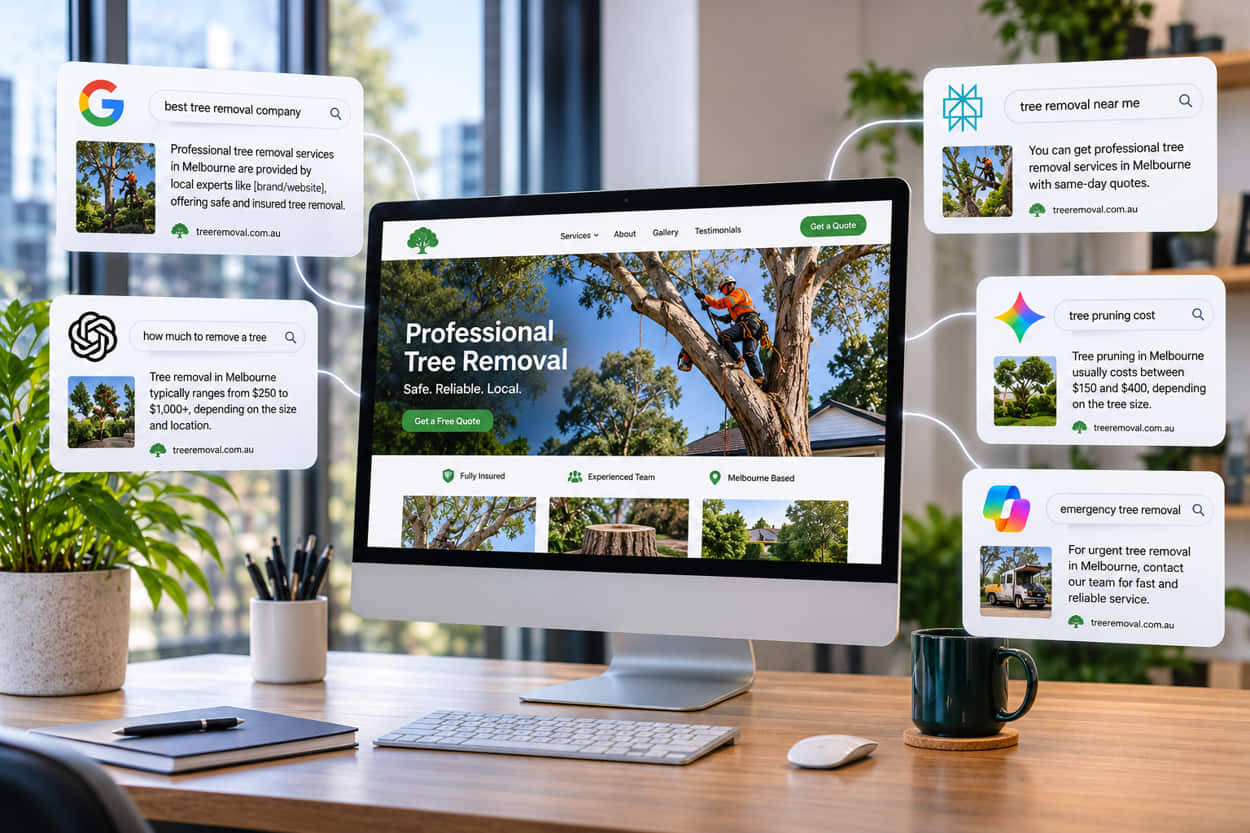
Your Google rankings look steady, yet fewer people click through to your website. It is a common story for Australian business owners right now. Google’s AI Overviews and AI Mode, ChatGPT, Perplexity and Gemini often answer a question before anyone visits a site, and they pick a small number of sources to quote.
AI search optimisation is the work of making your website one of those sources. In this guide, you will learn how each AI search tool finds content, the seven steps that improve your chances of being cited, the myths you can safely ignore and how to measure results.
One honest note before we start: no one can guarantee an AI citation. What you can do is make your site easy to find, easy to trust and easy to quote.
AI search optimisation means making your website easy for AI-powered search tools to find, understand and cite. Let AI search crawlers in, keep your SEO foundations strong, answer customer questions directly with first-hand detail, keep your business details consistent online, earn genuine mentions and track results in Search Console, Bing Webmaster Tools and GA4.
What is AI search optimisation?
AI search optimisation is the process of making your content easy for AI-powered search to find, understand and cite. That includes Google AI Overviews and AI Mode, ChatGPT search, Perplexity, Gemini and Microsoft Copilot.
Traditional search shows a list of links. AI search reads several pages, writes one answer and links to a few of the sources it used. Your goal is to be one of those sources, and ideally the business the answer recommends.
AI search optimisation, AEO and GEO: are they different?
You will see several names for this work: answer engine optimisation (AEO), generative engine optimisation (GEO), AI search engine optimisation, AI SEO and LLM SEO. They overlap heavily. Google’s own guidance says optimising for its generative AI features is still SEO, because it is the same search experience.
There is a lively debate about this on Reddit, and both sides have a point. The foundations really are the same. What changes is how answers are built, how people click and how you measure success.
| Traditional SEO | AEO | GEO | |
|---|---|---|---|
| Goal | Rank a page in search results | Be the direct answer to a question | Be cited or named in an AI-generated answer |
| Where you appear | Organic listings, map pack | Featured snippets, AI Overviews, voice answers | AI Overviews, AI Mode, ChatGPT, Perplexity, Gemini |
| Main measure | Rankings, clicks, enquiries | Answer visibility | AI impressions, citations, mentions, AI referrals |
AI mentions, citations and recommendations: what is the difference?
AI visibility comes in three forms, and they are worth separating:
- Mention: the AI answer names your business, with or without a link.
- Citation: the AI answer links to your page as a source.
- Recommendation: the AI answer suggests your business as the one to choose.
This guide focuses on the website work that earns mentions and citations. Recommendations depend more on your wider reputation, which we cover in Step 6.
How AI search engines choose which websites to cite
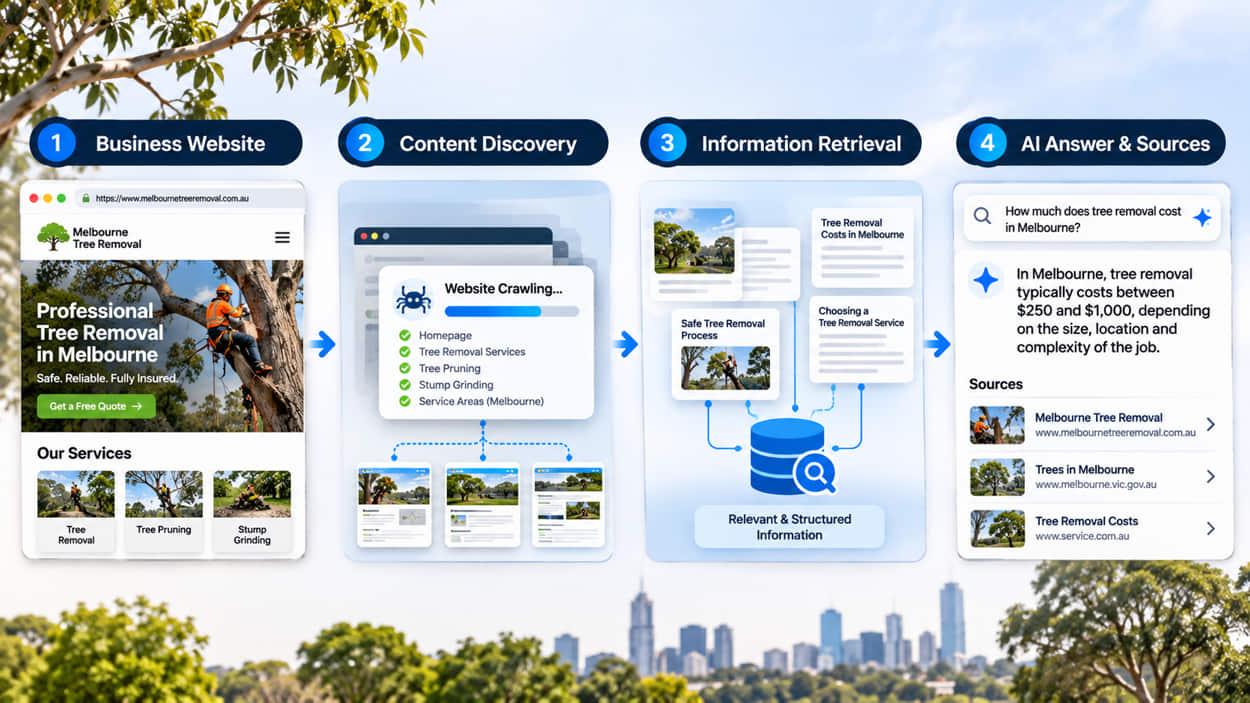
Each AI search tool finds sources in its own way, but they share one pattern. They search an index of web pages, read the most relevant results and build an answer from them. If your page is not in that index, or the crawler cannot read it, you cannot be cited.
How Google AI Overviews and AI Mode choose sources
Google’s AI features ground their answers in pages from Google’s normal search index, chosen by its core ranking systems. The model also runs related searches at the same time, a process Google calls query fan-out. A question about a leaking hot water system might also trigger searches about repair costs or replacement options.
To be eligible, a page must be indexed, able to show a snippet in Search and meet Google’s technical requirements. Google also says Business Profiles and Merchant Center product feeds can appear in AI responses, which matters for local and retail businesses.
How ChatGPT search finds websites
ChatGPT finds web sources through OpenAI’s search crawler, OAI-SearchBot. OpenAI says sites that block OAI-SearchBot will not be shown in ChatGPT search answers. A separate crawler, GPTBot, collects content for training AI models. You can block GPTBot and still allow OAI-SearchBot, because each setting works independently.
How Perplexity finds and cites sources
Perplexity uses PerplexityBot to surface and link websites in its results, and says this crawler is not used to train AI models. A second agent, Perplexity-User, visits pages when a person asks a question, and it generally ignores robots.txt because a user requested the visit. Perplexity does not publish how it ranks sources.
How Gemini and Microsoft Copilot use web content
The Gemini app can ground answers in Google Search content. A robots.txt token called Google-Extended controls whether Google can use your content for Gemini training and for grounding in Gemini Apps. Google says Google-Extended does not affect inclusion or ranking in Google Search.
Microsoft Copilot draws on Bing. Bing Webmaster Tools now reports how often your pages are cited in Copilot and Bing’s AI summaries.
| Platform | Where answers come from | Crawler to allow | Where to check results |
|---|---|---|---|
| Google AI Overviews and AI Mode | Google’s search index, plus fan-out searches | Googlebot | Search Console Generative AI report |
| ChatGPT search | OpenAI’s search index | OAI-SearchBot | GA4 AI Assistant channel, prompt tests |
| Perplexity | Perplexity’s index | PerplexityBot | GA4 referrals, prompt tests |
| Gemini app | Google Search grounding | Google-Extended (for Gemini use) | Prompt tests |
| Microsoft Copilot | Bing’s index | Bingbot | Bing Webmaster Tools AI Performance |
One more thing worth knowing: AI tools sometimes get details wrong or credit the wrong source. Clear, consistent and current information on your own website gives them less room for error.
Step 1: Let AI crawlers such as OAI-SearchBot and PerplexityBot reach your site
Why blocked crawlers keep you out of AI answers
Every AI search tool needs to read your pages before it can cite them. If a crawler is blocked, your content is invisible to that platform, however good it is. Blocks often happen by accident, through an old robots.txt rule, a security plugin or a firewall setting nobody has reviewed in years. That is why crawler access is the first check in any AI search optimisation plan.
How to set up robots.txt and firewall rules for AI search
Check your robots.txt file at yourdomain.com.au/robots.txt. Make sure it does not block Googlebot, Bingbot, OAI-SearchBot or PerplexityBot. A simple set-up for a business that wants to appear in AI search looks like this:
Next, check your CDN and security settings. If your site uses Cloudflare, review its AI crawler controls, which now separate search, agent and training crawlers. A blanket block can stop search crawlers as well. Perplexity also recommends allowing its published IP ranges in your firewall.
Finally, make sure your main content appears in the page’s HTML. Google recommends semantic HTML and good JavaScript SEO practice, and some crawlers may not run scripts the way a browser does.
How to confirm AI crawlers can access your pages
- Open robots.txt and read every Disallow line.
- Ask your developer or host to check server logs for visits from these crawlers.
- Use URL Inspection in Search Console and Bing Webmaster Tools.
OpenAI and Perplexity both say robots.txt changes can take about 24 hours to apply.
Not sure if ChatGPT, Perplexity and Google’s AI can see your website? Book an AI visibility check with GoingIT and get a clear list of fixes.
Book an AI visibility checkStep 2: Fix the SEO foundations that AI Overviews depend on
Why AI Overviews draw on pages that already rank well
Google’s AI features pull from the same index and ranking systems as normal search. Pages that are well indexed, fast and clearly structured are the ones most likely to be used. Good SEO for AI search starts with the same technical basics as any other SEO. AI search optimisation does not replace SEO; it sits on top of it.
Technical SEO checks for AI search
Start with indexing. Your important service and location pages must be indexed and able to show a snippet. Avoid adding nosnippet rules to pages you want cited.
Then work through the basics:
- One clear page for each service, without near-duplicate versions.
- Descriptive title tags and headings that match how people search.
- Internal links from your blog posts to the service pages they support.
- A fast, mobile-friendly site with a good page experience.
- Clean redirects and no broken links on key pages.
Large sites that update often should also manage crawl budget, so Google spends its time on pages that matter. For most small business sites, the bigger risk is thin or duplicate pages competing with each other.
If your site has not had a proper review in a while, a professional SEO audit will show which of these issues are holding you back and in what order to fix them.
How to find indexing and page health issues
- Search Console: open the Pages report and look for important pages marked as not indexed.
- Use URL Inspection on your top five service pages.
- Run a site crawl with a tool such as Screaming Frog to find duplicates, broken links and missing titles.
- Check Core Web Vitals in Search Console for slow page groups.
Step 3: Write answer-first content that AI Overviews and ChatGPT can quote
What makes content easy for AI tools to quote?
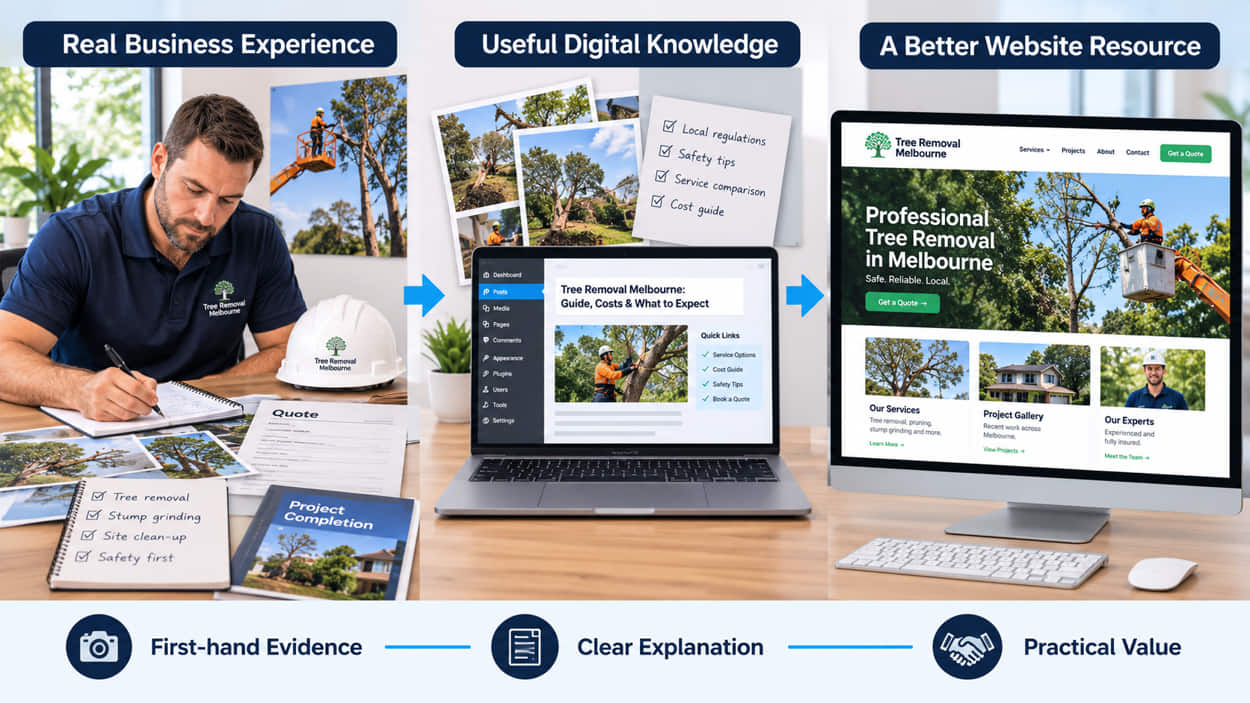
AI tools look for passages that answer a question clearly. A page that buries the answer under a long introduction is harder to use. Google also asks for content with a unique, first-hand perspective, not a rewrite of what is already online. If you are working out how to rank in AI Overviews, this is where most of the gains come from.
How to structure pages around customer questions
Open each section with a direct answer in one or two sentences, then add the detail. Use question-style headings that mirror how your customers ask. Good sources are Google’s People Also Ask boxes, Reddit threads in your industry, sales calls and your own enquiry forms.
Add proof that only your business can provide:
- Real job examples from Australian suburbs or cities you service.
- Photos and short videos of your work.
- Your process, timelines and price factors.
- Data from your own projects, clearly dated.
Cover the follow-up questions on the same page. Query fan-out means Google looks for related answers, so a page that covers cost, timing and next steps is more useful than one that answers a single question.
Avoid shortcuts. Google warns that mass-producing near-identical pages for every query variation breaks its scaled content abuse policy. It also says you do not need to chop content into tiny chunks or rewrite it in special language for AI.
How to test whether a page answers clearly
- Read the first two sentences under each heading. Do they answer the heading on their own?
- Ask a colleague to find your price factors or turnaround time in under 10 seconds.
- Compare your page with the sources an AI Overview cites for the same question.
Step 4: Use schema markup to make your business facts clear
Does schema markup help AI search?
Structured data, also called schema markup, labels the facts on your page in a format machines read easily: who you are, what you offer, where you work and who wrote the article. Google is clear that there is no special schema for AI and that structured data is not required to appear in its AI features. It still powers rich results and removes guesswork about your key facts.
Which schema types Australian businesses should add first
Use JSON-LD, the format Google recommends, and start with the types that suit most Australian service businesses:
- Organization on your home page, with your logo, ABN-registered name and social profiles.
- LocalBusiness (or a more specific type such as Plumber or Dentist) with address, phone, opening hours and service areas.
- Service on each service page.
- Article on blog posts, with the author’s name and role.
- BreadcrumbList across the site.
Make sure every detail in your markup matches what visitors can see on the page. Markup that says something different from the page is a quality problem, not a ranking trick.
A note on FAQ markup: Google stopped showing FAQ rich results in 2026, so do not add it expecting the old expandable answers in search. Keep your FAQs on the page for readers.
Our guide to auditing your site for structured data walks through this in more detail.
How to test and maintain your structured data
- Test key pages in Google’s Rich Results Test.
- Validate the full markup in the Schema Markup Validator.
- Review the Enhancements reports in Search Console for errors and warnings.
- Re-test after any theme or plugin update, as these often break markup.
Step 5: Keep your business details consistent on Google, Bing and directories
Why mismatched details lead to wrong AI answers
When an AI tool describes your business, it pieces together what it finds across the web. If your website, Google Business Profile and directory listings disagree on your address, services or hours, the answer can be wrong or vague. Google says Business Profiles can make your services visible in AI responses, so consistent details are a core part of AI search optimisation for local businesses.
Where to update your business information
Settle on one official version of your business name, address, phone number, services and service areas. Then update it everywhere:
- Your website footer, contact page and About page.
- Google Business Profile, including categories, services and photos.
- Bing Places for Business and Apple Business Connect.
- Australian directories that matter in your industry, such as Yellow Pages, True Local, Hotfrog and trade association listings.
Strengthen your About page with your team, qualifications, years in business, licences and the areas you service. These are the details an AI answer needs to describe you accurately, and they support trust signals for Google too.
If you serve several suburbs or cities, our local SEO guide explains how to build location pages without creating duplicates.
How to check what AI tools say about your business
- Search your business name with your suburb in Google and Bing, and review every listing on page one.
- Ask ChatGPT, Perplexity and Gemini what they know about your business, and note anything wrong or outdated.
- Fix errors at the source listing, not just on your website.
Step 6: Earn genuine mentions that AI search tools trust
Why third-party mentions shape AI recommendations
AI tools give more weight to businesses that other people talk about. Reviews, industry articles and community discussions help them judge whether a business is real, active and trusted. This is also where recommendations come from, which is the hardest form of AI visibility to earn.
Practical ways to earn mentions without spam
Focus on mentions that a real customer or journalist would also see:
- Ask happy customers for Google reviews, and reply to every review, good or bad.
- Join industry associations and keep your member listing current.
- Get listed on supplier, partner and manufacturer “where to buy” or “find an installer” pages.
- Offer expert comment to local media and industry publications.
- Appear on podcasts, webinars and credible “best of” lists in your field.
Reddit and forums can help too, but only with genuine participation. Answer questions as a named business owner and be open about who you are. Google says inauthentic mentions do not help and are caught by its spam systems, and Reddit communities are quick to call out disguised promotion.
How to track reviews and brand mentions
- Track your review count and average rating each month.
- Set up Google Alerts for your business name and key people.
- Run the same buyer prompts in AI tools each month and note which competitors are named and which sources are cited.
Step 7: Track AI search visibility in Search Console, Bing and GA4
Why AI visibility needs its own reporting
You cannot improve what you cannot see. Many owners notice that impressions hold steady while clicks fall, which is a sign AI answers are taking some of those clicks. Measuring AI search visibility shows where you appear, which pages earn it and whether your AI search optimisation work leads to enquiries.
Four ways to measure AI Overviews and ChatGPT visibility
Use four sources together, because each one sees only part of the picture:
- Google Search Console: the Generative AI performance report, launched in June 2026 and still rolling out, shows impressions in AI Overviews and AI Mode by page, country, device and date.
- Bing Webmaster Tools: the AI Performance report shows citations in Copilot and Bing’s AI summaries, which pages were cited and the grounding queries behind them. It does not show clicks.
- Google Analytics 4: since May 2026, GA4 groups visits from recognised AI assistants such as ChatGPT and Gemini into an AI Assistant channel. Some AI visits arrive without referrer data and show as Direct, and some platforms may still appear under Referral, so a custom channel group can fill the gaps.
- Prompt testing: each month, run 10 to 20 questions your buyers ask in ChatGPT, Perplexity, Gemini and Google AI Mode. Record whether you are mentioned, cited or recommended, and who is named instead.
AI answers change from one run to the next, so look for trends over several months rather than reacting to a single result.
What to review each month
- Compare AI impressions with organic clicks in Search Console each month.
- Review AI Assistant sessions and conversions in GA4.
- Keep prompt test results in one shared spreadsheet with dates.
Want help tracking and improving your AI search visibility? Talk to GoingIT’s SEO team about a plan built for your business.
Talk to our SEO teamAI search optimisation myths: what the evidence says
A new field attracts quick fixes. These are the claims we hear most from Australian business owners, and what the evidence says.
Myth 1: You need an llms.txt file to appear in AI search
llms.txt is a text file that lists a site’s key pages for AI tools. Google says its Search features do not use it, and keeping one will neither help nor hurt you in Google. An SE Ranking study of about 300,000 domains, reported by Search Engine Journal, found no clear link between having the file and being cited. It does no harm, but it should sit well below crawler access and content on your list.
Myth 2: There is special schema markup for AI
There is not. Google says no special structured data is needed for its AI features. Standard schema still helps with rich results and clarity, as covered in Step 4.
Myth 3: You must split every page into small chunks
Google says chunking content is not required and there is no ideal page length. Clear headings and direct answers matter more than cutting pages into fragments.
Myth 4: Content must be rewritten in AI-friendly language
AI systems understand synonyms and meaning. Write for your customers in plain language, and the AI tools will follow.
Myth 5: More pages for every question means more AI citations
Creating masses of near-identical pages to catch query variations breaks Google’s scaled content abuse policy. One strong page that covers a topic and its follow-up questions is safer and more useful.
Myth 6: An agency can guarantee your place in ChatGPT
Nobody controls what ChatGPT, Perplexity or Google’s AI says in its answers. ChatGPT has started testing ads, but OpenAI says they are labelled as sponsored, shown separately and do not influence the answers. Be wary of anyone selling guaranteed organic AI placement.
Is voice search optimisation still worth doing?
A few years ago, every business was told to optimise for voice search on smart speakers. That advice has not disappeared; it has been absorbed into AI search. Voice assistants and AI chat now draw on the same kinds of AI systems, and people ask them the same long, conversational questions.
The basics from our earlier guide to optimising your site for voice search still apply: answer questions in natural language, keep an up-to-date FAQ section and look after your Google Business Profile. Voice search optimisation is now one part of a wider AI search strategy.
How long does AI search optimisation take?
It depends on what you are fixing:
- Crawler access: OpenAI and Perplexity say robots.txt changes take about 24 hours to apply.
- Indexing and technical fixes: usually days to a few weeks, depending on how often search engines crawl your site.
- Content improvements: often a few months to show in rankings and AI answers, and longer in competitive industries.
- Reputation and mentions: built over quarters, not weeks.
There is no fixed timeline and no guarantee. The practical approach is to fix access first, improve your most valuable pages next and measure monthly so you can see what is working.
30-day AI search optimisation checklist for Australian businesses
Use this plan to put the foundations of AI search optimisation in place in one month. Each week builds on the last.
| Week | Focus | Tasks | Tools |
|---|---|---|---|
| 1 | Access and indexing | Review robots.txt and CDN or firewall settings; confirm key pages are indexed; fix noindex or nosnippet mistakes | Search Console, Bing Webmaster Tools, server logs |
| 2 | Content | Rewrite your top five service pages answer-first; add first-hand examples, photos and price factors; cover follow-up questions | Google People Also Ask, enquiry forms, sales notes |
| 3 | Facts and markup | Align Google Business Profile, Bing Places, Apple Business Connect and directories; add or fix Organization, LocalBusiness and Service schema | Rich Results Test, Schema Markup Validator |
| 4 | Measurement | Check the Search Console Generative AI report and Bing AI Performance; review the GA4 AI Assistant channel; run your first 10 to 20 prompt tests | Search Console, Bing, GA4, a shared spreadsheet |
AI search optimisation FAQs
Is SEO dead now that AI answers questions?
No. Google’s AI Overviews and AI Mode draw on Google’s search index, and ChatGPT, Perplexity and Copilot all search the web before they answer. Strong SEO is the base for AI visibility. What has changed is that simple questions often get answered on the results page, so clicks drop and measurement needs new reports.
What is the difference between SEO, answer engine optimisation (AEO) and GEO?
SEO aims to rank your pages in search results. Answer engine optimisation (AEO) aims to make your content the direct answer to a question. Generative engine optimisation (GEO) aims to get you cited or named in AI-generated answers. Google treats all three as SEO, because they share the same foundations. The outcomes and the metrics are what differ.
Is AI search optimisation worth it for a small business?
Usually, yes, when it is part of your SEO rather than a separate project. Start with the low-cost steps: crawler access, strong service pages and an accurate Google Business Profile. Increase your investment once Search Console, Bing or GA4 show AI impressions or referrals growing.
How do I rank in Google AI Overviews?
There is no form to apply, and AI Overview SEO is mostly good SEO done well. Your page must be indexed and able to show a snippet, rank well for the question and related searches, and answer the question clearly near the top. Covering follow-up questions on the same page helps, because Google runs related searches when it builds an AI Overview.
How do I optimise for Google AI Mode?
Use the same approach as AI Overviews. AI Mode also uses Google’s index and fan-out searches, so in-depth pages that cover a topic and its follow-up questions do well. Keep your Google Business Profile and any Merchant Center product data accurate, and check the Generative AI report in Search Console.
How do I get ChatGPT to mention or cite my business?
Allow OAI-SearchBot in your robots.txt, publish clear answer-first pages, keep your business details the same everywhere and earn genuine mentions on trusted sites. ChatGPT’s answers change between runs, so test the same buyer questions each month.
Can I pay to appear in ChatGPT or Google’s AI answers?
Not in the answers themselves. You cannot apply or pay to be cited in organic AI answers. ChatGPT has begun testing ads and Google shows ads around AI Overviews, but these are labelled and separate. OpenAI says its ads do not influence ChatGPT’s answers. Be cautious of anyone promising guaranteed AI placement.
Why has my traffic dropped when my rankings have not changed?
AI Overviews often answer simple questions directly on the results page, so fewer people click through, even when your position stays the same. In Search Console, look for impressions holding steady while clicks fall. Then focus on commercial pages, such as service and pricing pages, where people still need to visit a website.
Do I need an llms.txt file?
Not for Google, which says its Search features do not use llms.txt. A large SE Ranking study found no clear link between the file and AI citations. Adding one does no harm, but crawler access, indexing and useful content will do far more for your AI visibility.
Does schema markup help with AI search?
It helps search engines read your key facts and supports rich results in Google. Google says structured data is not required for its AI features and there is no special AI schema. Use it to keep your business information clear and accurate, not as a shortcut to citations.
Should I block GPTBot and other AI crawlers?
It depends on your goal. Blocking GPTBot stops OpenAI from using your content for training, but it does not remove you from ChatGPT search. Blocking OAI-SearchBot or PerplexityBot removes you from those search answers. Most businesses that want AI visibility allow the search crawlers and decide separately about training.
How do I track traffic from ChatGPT and AI Overviews?
Use three free tools. Search Console’s Generative AI report shows impressions in AI Overviews and AI Mode. Bing Webmaster Tools shows citations in Copilot. GA4’s AI Assistant channel groups visits from recognised AI tools. Some AI visits arrive without referrer data, so add monthly prompt tests to fill the gaps.
Where to start with AI search optimisation
AI search optimisation is not a separate trick. It is good SEO, applied to how people now search. Let the right crawlers in, keep your foundations strong, write answer-first pages with real first-hand detail, keep your business facts consistent, earn genuine mentions and measure what happens.
The results build over time, and no one can promise a citation. But the businesses that do this work consistently give AI tools every reason to find them, trust them and name them.
At GoingIT, we help Australian businesses improve their visibility across Google and AI search. If you would like a second opinion on where your website stands, our SEO team is happy to help.


